







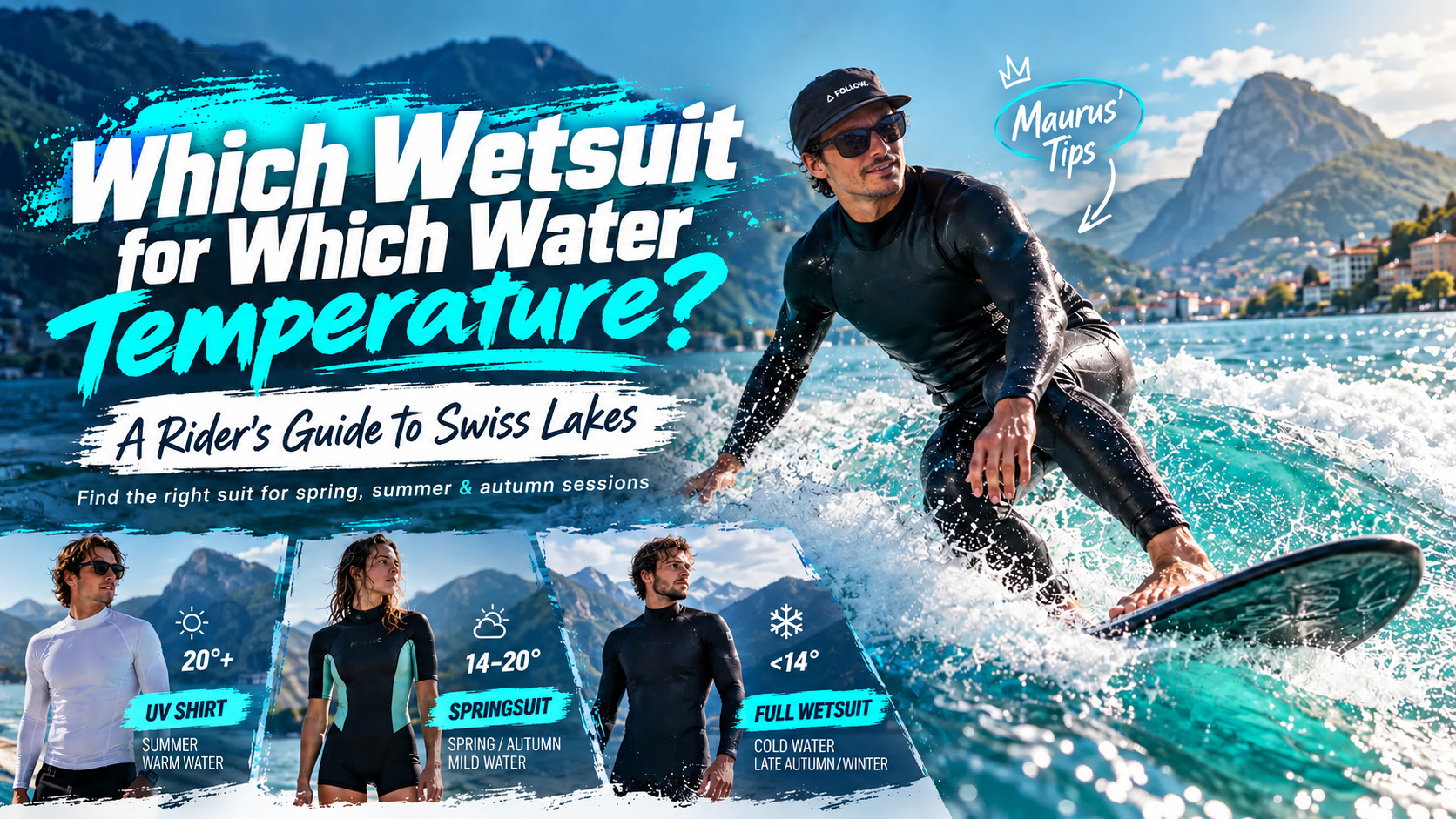
Which Wetsuit for Which Water Temperature? A Rider’s Guide to Swiss Lakes
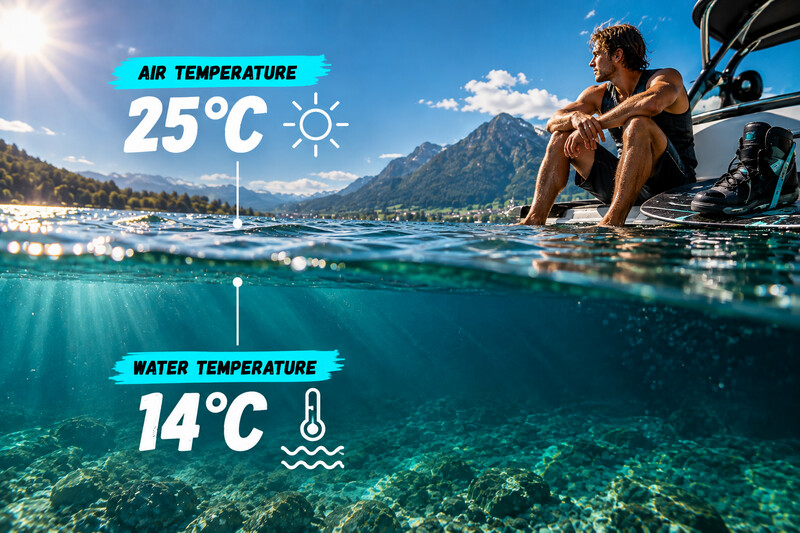
In May the thermometer on the jetty reads 25 degrees, while the lake underneath might be sitting at 14. That gap decides whether you still enjoy your third run or end up shivering in the boat with blue lips.
Maurus Zwicker, founder and head coach of our academy, shows you which suit actually works in which water.
Why water temperature matters more than air
No wetsuit temperature guide can replace a look at the lake itself, because the water decides and not the weather forecast. At Wakefactory we see the same thing every spring. The sun is out, the jetty feels warm. Your first fall still feels like an ice bath.
Large lakes take on heat very slowly. While the air in May already flirts with 25 degrees, the water often lags weeks behind. On top of that come sudden drops. According to the Swiss Federal Institute of Aquatic Science and Technology (Eawag), the Geneva basin of Lake Geneva fell from 19 to 11 degrees within a few days over the Whitsun weekend of 2025, after wind pushed cold deep water to the surface. Something similar happens in early summer almost every year.
What counts is the water temperature on the day of your session. Use the averages below for planning. For daily readings, the Federal Office for the Environment publishes live data for many Swiss lakes:
| Month | Lake Zurich | Lake Lugano | Lake Lucerne |
|---|---|---|---|
| April | approx. 12 °C | approx. 12 °C | approx. 8 °C |
| May | approx. 16 °C | approx. 16 °C | approx. 12 °C |
| June | approx. 20 °C | approx. 21 °C | approx. 17 °C |
| July and August | 22 to 24 °C | 22 to 23 °C | 21 to 22 °C |
| September | approx. 21 °C | approx. 20 °C | approx. 19 °C |
| October | approx. 15 °C | approx. 17 °C | approx. 15 °C |
Since these are rounded averages, individual days can differ quite a bit. Our academy riders in Agno check the current water temperature first and only then look at the wetsuit temperature guide. The calendar alone never picks the suit.
Our wetsuit temperature guide for Swiss lakes
The wetsuit temperature guide below comes straight from Maurus, who has spent many seasons riding and coaching on Swiss lakes. It is built for wakeboarding and wakesurfing, not for Atlantic surf trips or diving:
| Water temperature | Recommendation | What to watch |
|---|---|---|
| from approx. 22 °C (72 °F) | UV shirt | protection from sun rather than cold |
| approx. 18 to 22 °C (64 to 72 °F) | 1 to 2 mm springsuit | short or long sleeves depending on how easily you feel the cold |
| approx. 14 to 18 °C (57 to 64 °F) | 3/2 to 4/3 mm | the model makes the biggest difference |
| below approx. 14 °C (57 °F) | 4/3 to 5/4 mm | a high-end 4/3 can still work just below 10 °C (50 °F) |
Think of it as a wetsuit temperature chart for riding behind a boat, not for paddling out. Most brands publish their own ranges, often rating their suits a little warmer. O’Neill puts the 2 mm springsuit at around 21 degrees and up, Rip Curl places the 3/2 at roughly 14 to 20 degrees.
Why are our values more cautious? Wake sports cool you down differently. You start in the water, fall more often and then ride through the wind at speed.
What 3/2, 4/3 and 5/4 mean on a wetsuit
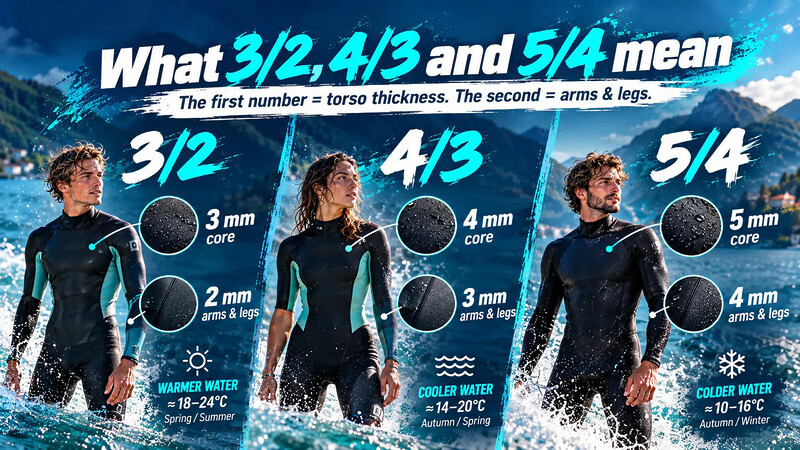
Wetsuit thickness is given in millimetres, always as two numbers. The first number is the neoprene thickness around your torso, the second covers your arms and legs. A 4/3 therefore has 4 mm across chest and back and 3 mm on the limbs.
The idea is simple. Your core should stay warm while arms and legs keep moving freely. Behind the boat that is more than comfort, since you hold the handle against the pull with slightly bent arms for minutes at a time. So look at both numbers when you compare suits, because a 4/3 in very stretchy neoprene can feel more mobile than a stiff 3/2.
Seams and zips keep you warm too
How much water gets inside depends on construction as much as on thickness. Flatlock seams are stitched all the way through and meant for warm water. Glued and blind-stitched seams, where the needle never fully pierces the neoprene, seal far better. For cold water, taped or sealed seams are added on top.
Any wetsuit thickness guide will tell you the numbers, but the entry system matters as well. A back zip is the easiest to get into, yet seals less well. Chest zip and zip free suits sit closer to the body, flex more and let in less water. The trade-off is a little more patience when you pull them on.
Rash guard or springsuit in high summer?
At the warm end of our wetsuit temperature guide, from around 22 degrees, Maurus keeps it simple. A UV shirt is all you need. It protects your shoulders and back from a sun that feels gentler on the water than it really is. Remember sun protection for your face too, since the surface reflects the light. You will find suitable UV-Shirts for those days in our shop.
Once the water cools to about 18 to 22 degrees, he recommends a 1 to 2 mm springsuit. Short or long sleeves? That mostly comes down to how quickly you get cold.
Maurus’ favourite with short legs and long sleeves
For this range, Maurus personally reaches for a springsuit with short legs and long sleeves, such as the Dawn Patrol Long Sleeve 2/2 from Rip Curl with a chest zip. In his experience, your shoulders and arms catch most of the wind while riding, whereas short legs leave your knees completely free for landings.
The Dawn Patrol is made from E5 neoprene with a foam based on natural rubber. Its seams are glued and blind-stitched. On a fresh June morning or a windy September afternoon, that tighter build makes a noticeable difference. For the middle of the wetsuit temperature guide, from cool mornings to sunny afternoons, it is a very flexible choice.
Where the model matters between 14 and 18 °C
In this band Maurus suggests either a 3/2 or a 4/3, depending on the suit. Which one fits depends more on the model than on the number on the label. This is exactly where a basic wetsuit temperature guide reaches its limits, because lining, seams and neoprene quality shift the result.
With high-end wetsuits such as the Rip Curl Flashbomb or the O’Neill Hyperfreak Fire, a 3/2 is often enough in his experience. Both rely on very stretchy neoprene and a warming inner lining. The Flashbomb uses Rip Curl’s flash lining, while O’Neill builds the Hyperfreak Fire with TechnoButter Firewall zones containing graphene fibres designed to return body heat. Good materials can make up for a whole thickness step.
Do you get cold quickly, or is your suit a more affordable model? Then a 4/3 is the safer choice. Our Long Suits range runs from 3/2 up to 5/4, so you can compare both options side by side.
Cold lake water in spring and autumn
Once the lake drops below about 14 degrees, our wetsuit temperature guide moves up to a 4/3 or 5/4. Quality counts just as much here. According to Maurus, a Flashbomb 4/3 still works very well even slightly below 10 degrees. If your suit only just covers the conditions, a long session quickly turns into a shivering match.
Cold water is not only a comfort issue. The Swiss Lifesaving Society (SLRG) warns against jumping into cold water while overheated, as blood vessels constrict abruptly and blood pressure rises sharply. Never ride alone in cold water, always wear a vest and stop as soon as you start to shiver. Shorter sessions with breaks out of the wind are the better call in April and October.
What you do after the water matters as well. Take off the wet suit right after your session, dry off and get into warm clothes. The SLRG advises avoiding windy spots while you do. A surf poncho makes changing on the jetty a lot easier.
Cold sensitivity, wind and session length
Treat any wetsuit temperature guide as a starting point rather than a rule, Maurus stresses with every recommendation. Two riders on the same lake on the same day can feel the cold completely differently. Besides the water temperature itself, these factors play a big part:
- Cold sensitivity: some people freeze at 20 degrees, others still ride a springsuit at 17.
- Wind and weather: clouds, rain and wind draw extra heat out of a wet suit.
- Time on the water: one long session with lots of falls costs more warmth than three short runs.
- Breaks in the boat: sitting wet in the wind while the boat moves often cools you faster than the water itself, in our experience.
Weigh these points together and you will rarely get it wrong. When in doubt, go one step warmer. A suit that is slightly too warm is uncomfortable, one that is too cold ends your day.
Why drying time matters when you ride several sessions a day
Ride more than once a day and a new factor comes in that hardly any wetsuit thickness chart mentions. Climbing back into a cold, wet suit after lunch costs willpower and body heat before you have even touched the water.
For days like these, Maurus recommends the Flashbomb 4/3 by Rip Curl. Its inner material dries very quickly, which makes the second and third session far more pleasant. Rip Curl itself puts this feature front and centre, stating that you will be dry in 30 minutes or less.
Hanging the suit up between sessions? Choose a shady spot and turn it inside out. That way the inside dries first, which is the side you feel when you step back in.
So choosing a suit for a given water temperature is not only a question of thickness, it also depends on how your day looks. If you would like help with size, model or thickness, we are happy to advise you personally. Our full Wetsuits range gives you an overview of every model.
Frequently asked questions about choosing a wetsuit
Which wetsuit do I need for 18 °C water?
Eighteen degrees is the classic grey zone in any wetsuit temperature guide. If you feel the cold easily or stay out for a long time, a 3/2 keeps you more relaxed. With sunshine and short runs, many riders get by with a springsuit, ideally one with long sleeves.
How tight should a wetsuit fit?
Even the best wetsuit temperature guide only works if the fit is right. A wetsuit should fit like a second skin, snug but without restricting you.
There should be no folds at the armpits, lower back or backs of the knees, otherwise cold water flushes through with every fall. O’Neill suggests a simple test when trying one on: you should be able to touch your toes and circle your shoulders freely.
Can one wetsuit cover the whole season?
On Swiss lakes, usually not. No single suit handles the spread from around 8 to 24 degrees that a full-season wetsuit temperature guide has to cover. Many riders get through the year with two, a springsuit for summer plus a 4/3 for spring and autumn.


