







Tip 2: The Right Boat Speed and Rope Length for Beginner Wakeboarders
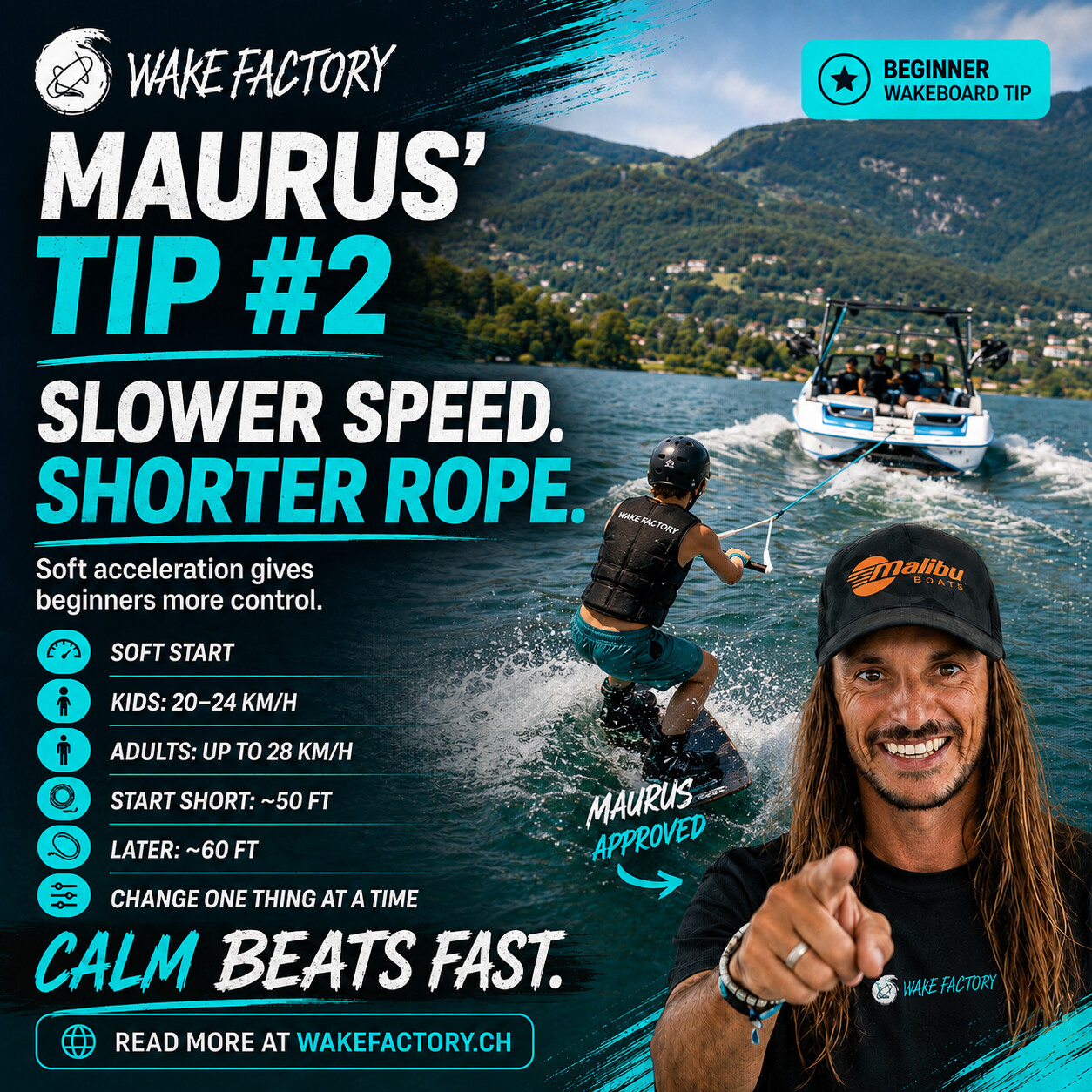
Two numbers shape a first session more than any board does: how fast the boat runs and how long the rope is. Both get set too high almost every time. In tip 2, Maurus Zwicker explains why less genuinely works better here.
It starts with the driver, not the rider
No first start depends on the rider alone. Anyone who takes someone out behind the boat for the first time at Wakefactory notices within minutes how much of it gets decided at the wheel. With the rider settled in the water, the boat should not launch abruptly but pull away softly and let the speed for wakeboarding build progressively.
A sudden yank makes the whole point of tip 1 impossible. Staying compact in that crouch does not work when the boat rips you out of a standstill. The smoother the acceleration, the less you have to do yourself.
The best speed for wakeboarding, by rider and by weight
There is no single correct speed for wakeboarding, because it depends on height, weight, board and experience. As a starting point we work with two rough figures:
- Children: roughly 20 to 24 km/h
- Adults: up to roughly 28 km/h
Lighter riders generally need less. The best speed for wakeboarding therefore lands in a range rather than on one fixed number. A universal minimum does not follow from that, though, because a light child already planes cleanly at 20 km/h while a heavier adult needs noticeably more pull to get up onto the surface at all.
Rushing this gains you nothing. Riding a little slower makes learning easier and falls considerably softer. Water gets harder with every extra km/h, something you notice the first time you land flat on your back. A properly fitted vest belongs in the boat from the very first run, even at calm speeds.
Wakeboard rope length for your first attempts
For the very first attempt, attach the rope at its shortest section. On many ropes that works out around 50 feet. The reasoning is simple: the pull arrives from a slightly higher angle and lifts you out of the water more easily.
When the start works reliably and you feel settled behind the boat, you can extend to roughly 60 feet. Further back the wake flattens out. That pays off in every later drill. Beginner wakeboard rope length is not a fixed figure either. It is simply the shortest setting your wakeboard rope offers, and most of them carry several attachment points.
Speed and rope length work as a pair
Wakeboard speed and rope length never act on their own. Short rope, moderate pace: that pairing gives you a calm, controllable setup. A long rope combined with high speed overwhelms beginners twice over, because the pull hits harder while more distance sits between boat and rider.
So when something is not working, change one thing at a time. Adjust the speed for wakeboarding by two or three km/h, run a lap, then look at the rope. Otherwise you will never know which change actually made the difference.
A calm setup buys the rider time
Soft acceleration, a short rope and moderate pace all serve the same purpose. They give you time to understand what the board underneath you is doing. That time is exactly what most first sessions lack. Not because of missing talent, but because of a setup that ran too hard from the start.
Calm beats fast: a moderate speed for wakeboarding gets a beginner further than raw pace ever will. If nobody at the wheel can judge that yet, a coach takes over that part for you. Our wakeboard lessons run out of Agno, on the Ticino side of the lake. With the start sitting properly, the next question becomes how you stand on the board. That is tip 3.


