







How to Make Your First Heelside and Toeside Turns
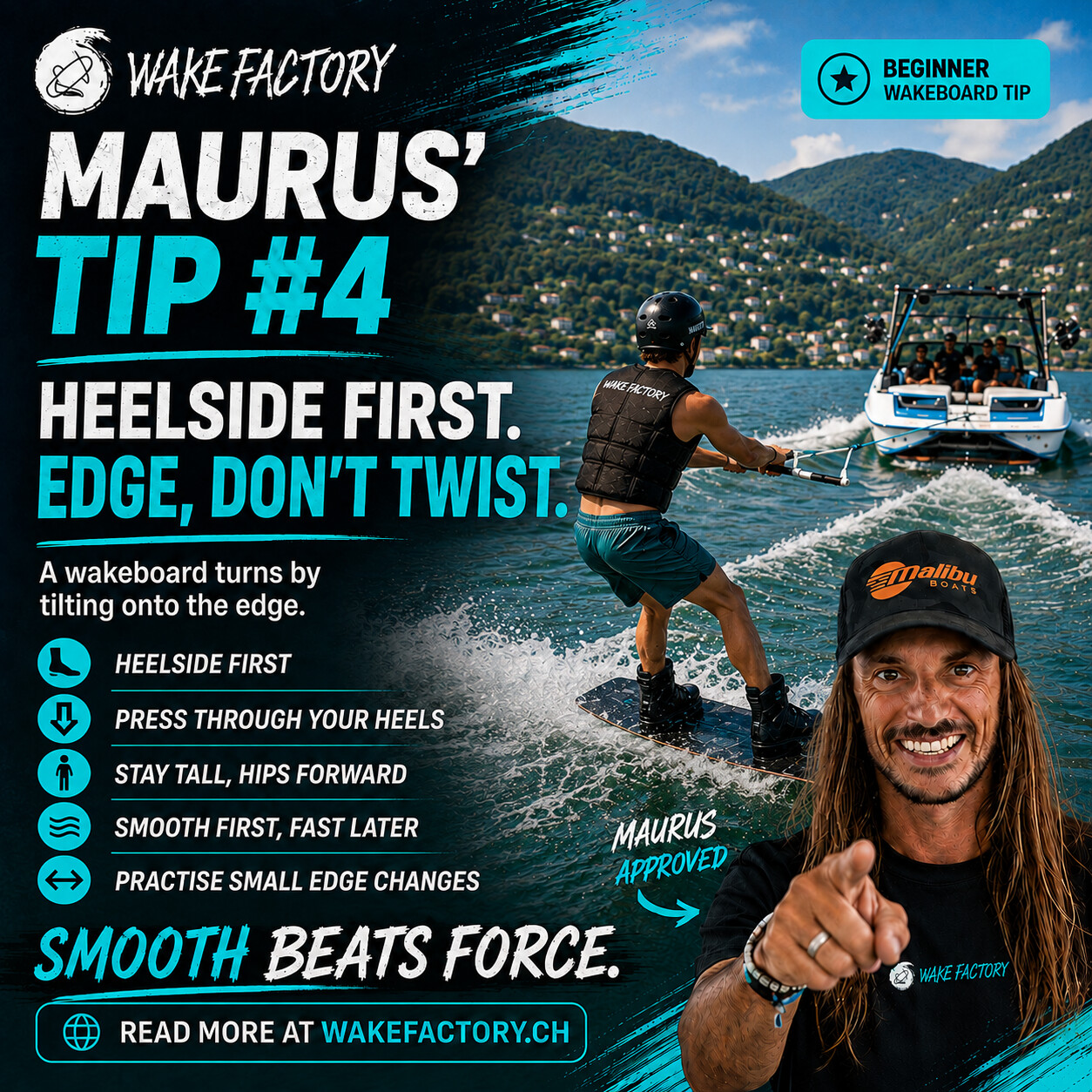
Most people first try to twist the board around with their feet. It does not work, and the reason is plain physics. A wakeboard is not turned, it is tilted onto an edge.
What heelside and toeside actually mean
Learning how to turn on a wakeboard starts with two words that sound more technical than they are. Heelside means pressure on your heel edge, toeside means pressure on your toe edge. That is the whole concept.
Why the heel edge first? Because it feels more natural to almost everyone. The pull of the rope sits in front of you, and your body slides into a stable position on its own. Toeside comes afterwards.
How to turn on a wakeboard, heelside first
Stay between the two wakes behind the boat for your first attempts. Crossing the wake is two steps away, right now this is only about small, clean changes of direction.
Your upper body stays tall, your hips push forward, your shoulders do not collapse backwards. From that position you gradually load pressure through your heels and let your upper body lean slightly away from the rope.
Two things then happen at once. Rope tension climbs, edge pressure grows along with it. The more of both you create, the faster the board travels sideways. That is the engine behind every turn, not footwork. How directly the edge responds also comes down to the gear, since boat boards are built for exactly this kind of edging behind a boat.
Do not rush the edge
Here is where the most common mistake shows up, nearly always out of impatience. Plenty of riders yank the turn in as hard as they can straight away. Because water needs a moment to build any pressure against the edge, that turn simply goes nowhere.
Start gently instead and let the edge grow stronger as the turn develops. Maurus sums it up in the academy with four words: smooth first, fast later.
Switching to toeside keeps the same principle, the body position simply feels less familiar at first. These four points belong together:
- chest and shoulders rotate slightly towards the boat
- hips and board point where you want to travel
- stay tall, hips forward
- hold your body tension, then press through your toes
Do not try to force the board around. Eyes, hips and board all work towards the same direction, otherwise you end up fighting your own wakeboard.
Stay inside the wake until edge changes feel smooth
Resist the urge to ride all the way out immediately. Practise small movements from left to right behind the boat instead: onto the heel edge, back to a flat board, then onto the opposite edge. Unremarkable, and still the actual foundation.
When those changes flow, you have essentially worked out how to turn on a wakeboard. Anyone wondering how to turn wakeboard drills into real progress ends up right here, on this exercise. Crossing the wake then turns out easier than it looks from behind. Tip 5 takes you across for the first time.


